
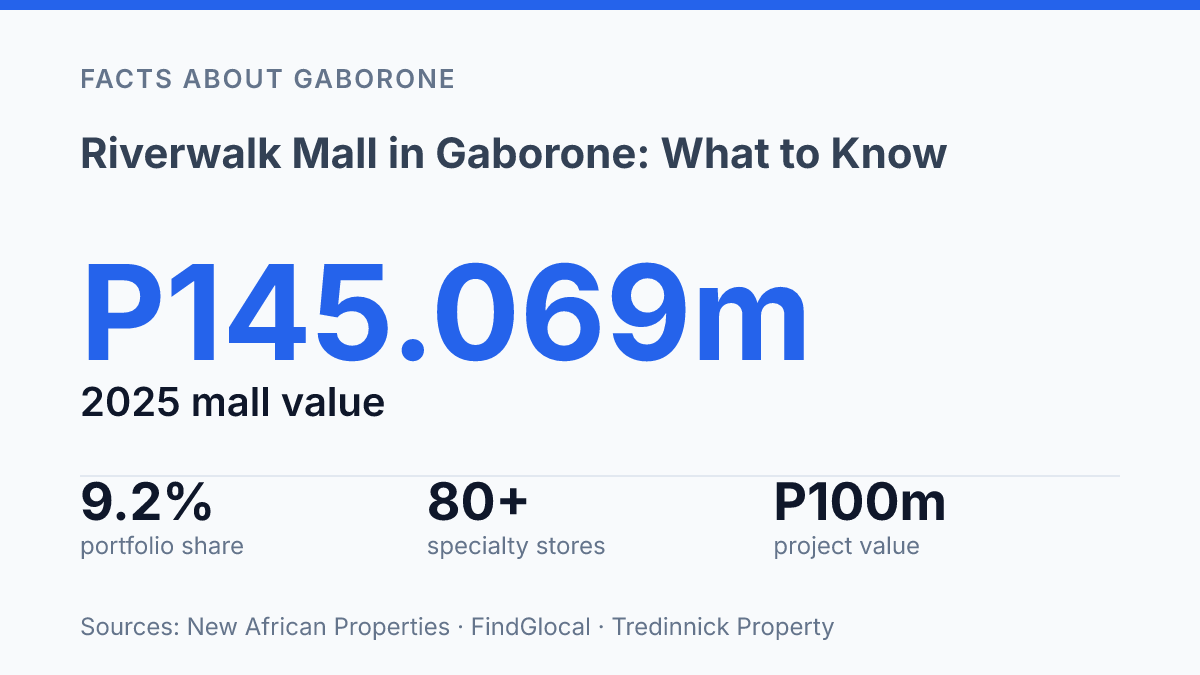
Riverwalk Mall is not just another Gaborone shopping stop: in New African Properties’ 2025 books, it was a P145.069 million asset and 9.2% of the company’s portfolio by value. That number changes how you read the place.
The cafés, cinema, banks, fashion chains and grocery anchors are not random conveniences. They are the machinery of a mall that grew from a P100 million 2003 development linked to the Botswana Development Corporation.
But the useful part is not just what sits inside. Riverwalk works because people use it in layers: errands, meals, films, ATMs, public activations, and meetups that stretch a “quick stop” into half a day. In my honest opinion, that’s why it matters more than cleaner, newer retail boxes. This guide looks at that mix, and at the riverside identity that gives the complex its charm… and its risk.
Why Riverwalk Mall sits at the center of Gaborone shopping
By 2025, Riverwalk Mall carried a property value of P145.069 million, a number that says more about its pull than any brochure could. New African Properties listed it as 9.2% of its portfolio by value.
This isn’t just a convenient place to shop. It’s one of the serious retail assets in Botswana’s capital.
Its position helps explain that weight. The complex sits in Gaborone, near the Notwane River in the central part of the city, close enough to feel accessible from several everyday routes. That gives it an advantage over smaller neighborhood plazas, where convenience is local but the draw is narrower.
The name does some quiet work too. “River walk” points to the nearby waterway, not only to shopping, parking, and checkout lines. In my view, the name sounds calm and scenic. The real story is commercial power… and that contrast is what makes the place memorable.
The modern retail story began in 2003, when Riverwalk Shopping Centre was developed in partnership with the Botswana Development Corporation at a project value of P100 million, according to Tredinnick Property. That origin matters. It places the centre inside Gaborone’s shift toward larger, planned shopping destinations rather than scattered stand-alone retail.
Compared with other shopping options in the city, the difference is scale and habit. A small strip of shops can solve one errand. A formal centre can hold a longer visit, pull mixed crowds, and become part of how people plan a day.
Riverwalk stands out because it does that without sitting on the edge of relevance. It remains one of the city’s largest and most popular commercial stops.
There’s a tradeoff, of course. Size brings traffic, noise. The feeling that the place is always in motion.
But that pressure is also the proof. In Gaborone retail, quiet doesn’t always mean central. Crowds often do.
What you’ll find inside the complex
A cinema inside a shopping centre changes the rhythm of a visit: people arrive for errands and stay long after the bags are in the car. That’s the key to this complex.
It isn’t only a place to buy groceries, clothes, electronics, or pharmacy items. It also gives people reasons to sit down, eat, meet friends, watch a film, and stretch a quick stop into part of the day.
Scale matters here, but not as a bragging point. The mall’s public profile, mirrored by FindGlocal, claims more than 80 specialty stores plus entertainment and cinema.
New African Properties’ 2025 Integrated Annual Report also names 16 major tenants at the property, with categories spanning food, fashion, home, electronics, health, and leisure. That mix explains the repeat foot traffic better than any single shop could.
Tourists read that mix differently. For a visitor, the draw is predictability: food options, familiar retail formats, banking access. A safe place to pause between plans.
For locals, the appeal is habit. You can run practical errands, meet someone for lunch, and still have a low-effort evening option if the day shifts. In my honest opinion, that flexibility is the real product being sold here.
The same convenience creates the catch. The stronger the all-in-one appeal becomes, the less reason people have to leave once they arrive.
That’s good for tenants inside the complex. It can pull spending and attention away from older commercial areas that depend on foot movement between separate shops.
This modern format also changes expectations. Compared with older street-based retail zones, the experience feels more contained, planned, and leisure-led. A public-engagement activation by Botswana’s National Planning Commission on 13 December 2024 shows the point.
The site can handle more than shopping traffic. It can absorb civic events, casual visitors, and entertainment crowds. The presence of Nu Capitol Cinemas makes that role even clearer.
Why locals and tourists treat it as a stop, not just a store run
A place that can appear in a film festival program in October and still handle a bank stop before lunch has a different kind of pull. The Bantu Film Festival listing names the Riverwalk cinema venue for 20–24 October 2026, with an audience figure of 150, according to FilmFreeway. That puts ordinary errands and planned entertainment in the same frame.
That range explains why locals don’t treat the complex as a single-purpose stop. You can get through practical tasks, meet someone for coffee, browse without a strict plan, then stay longer than intended.
The trip starts as admin. It can end as an outing.
Visitors get a different benefit: easy time. When you don’t know a city well, a familiar public space cuts the guesswork. It gives you somewhere to pause, eat, shop for basics, and read the rhythm of Gaborone without building a whole itinerary around it.
The practical layer matters too. The mall’s public profile mirrored by FindGlocal lists five ATM or bank options, a small detail that changes how people use the place. Money, meals, shopping, a movie: the trip stacks.
But In my humble opinion, the interesting part is that a mall can feel both routine and special at the same time… and Riverwalk Mall pulls that off better than most city centers. That contrast is the draw. People don’t need to choose between getting things done and taking a breather.
That balance is hard to manufacture. Too much convenience can make a centre feel like a corridor.
Too much leisure can make it feel planned and expensive. Riverwalk’s appeal sits in the middle: people arrive for something ordinary, then give themselves permission to linger.
How the riverside setting shapes its identity
A name that sounds like a promenade survived because the place became a landmark, not because people came looking for a river view. The link to the Notwane River gives “Riverwalk” a clean mental hook.
You hear the name once. It points to a place rather than a tenant list.
That matters in Gaborone. A growing capital can fill quickly with plazas, centers, blocks, and branded developments that blur together.
Place-based naming cuts through that sameness. It gives the complex a civic shorthand: not just where to buy something, but where in the city people mean.
The contrast is the useful part. A river name suggests scenery first, commerce second… but here, the commercial draw is exactly what made the name stick. The riverside reference gave it character, then daily use gave it weight. In my view, that combination is why the name feels more durable than a purely corporate label.
There’s a sharper edge to the setting too. Mmegi reported that the Notwane is the only river in Gaborone that can claim real estate directly tied to scenery, naming Riverwalk near Tlokweng as part of that pattern.
That gives the address cachet, but water is never just branding. The IFRC reported that major commercial centres, including the complex, sustained substantial damage during February 2025 flooding.
So the riverside identity works on two levels. It gives the mall a softer public image, one attached to movement, leisure, and location. At the same time, the site remains a serious commercial asset in a city where New African Properties said its top 10 assets made up 73.9% of portfolio fair value at 31 July 2025.
The name sounds relaxed. The role is anything but.
What the river gives and what the lease clock changes
The calendar matters now: May 2026 puts the majority lease under the spotlight. That detail should shape how owners, tenants and regular visitors read the next phase. A mall can look settled from the parking lot, but property value depends on paperwork as much as foot traffic.
The Notwane River gives the place a setting most Gaborone centres can’t copy. It also proved, during the 2025 floods, that scenery carries a cost. With more than 80 specialty stores, the complex still has real pull. In my humble opinion, the smart move is to treat its convenience as only half the story.
The other half is resilience. If Riverwalk Mall wants to stay central, it has to defend the place as carefully as it rents it.
Frequently Asked Questions
Q: Where is Riverwalk Mall located in Gaborone?
A: Riverwalk Mall sits in the central part of Gaborone, near the Notwane River. That location makes it easy to reach from the city center. The setting still feels a little removed from the rush. In my view, that balance is a big part of why people keep going back.
Q: Why is Riverwalk Mall called Riverwalk?
A: The name comes from its spot near the Notwane River. It literally translates to “river walk,” which fits the location well. The name is simple. It gives the place a clear identity.
Q: Is Riverwalk Mall one of the biggest malls in Botswana?
A: Yes. Riverwalk Mall is one of the largest shopping centers in Botswana’s capital, and size matters here because it gives you more choice in one stop. It’s popular for shopping and leisure, not just retail.
Q: What can you do at Riverwalk Mall besides shopping?
A: People go there for more than stores. It’s a common spot for leisure too. You can spend time there without treating it like a quick errand. That mix is what makes it useful for locals and tourists alike.
Q: Is Riverwalk Mall good for tourists visiting Gaborone?
A: Yes, it’s a solid stop if you want a familiar, modern place in the city. Tourists like it because it’s easy to navigate and gives you a straightforward shopping and leisure break. It’s not trying to be a landmark… it just works.