
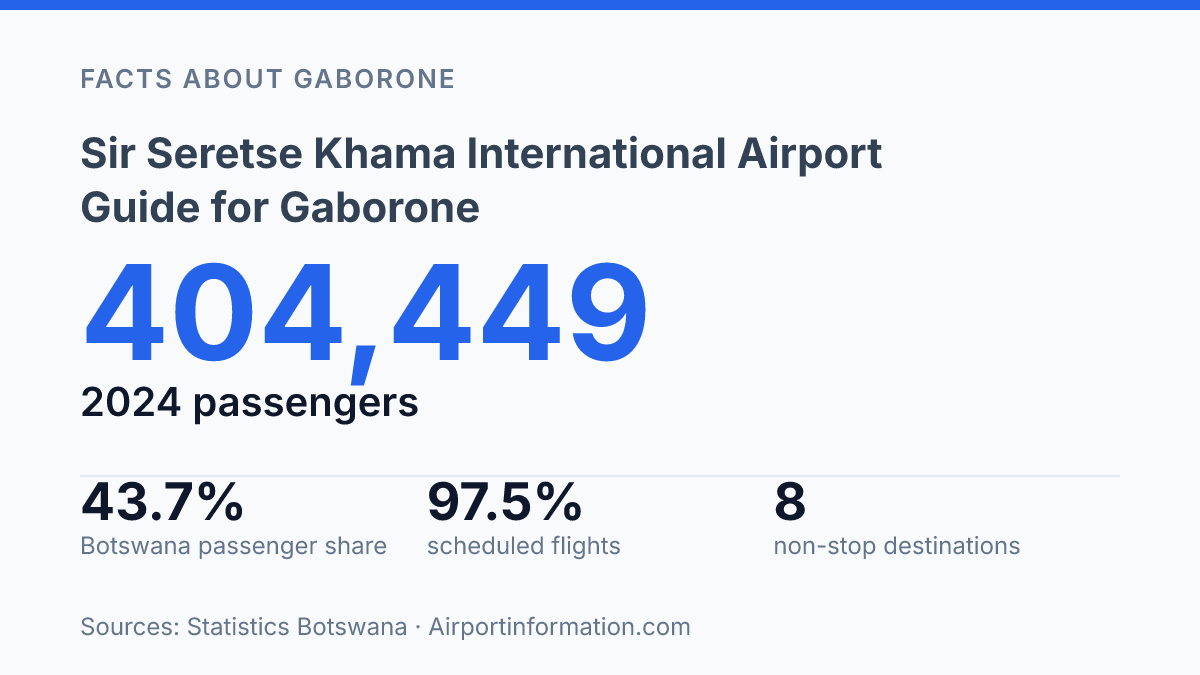
Sir Seretse Khama International Airport moved 393,438 scheduled passengers in 2024. It logged far fewer aircraft movements than Maun, the safari gateway crowded with light aircraft.
That split explains Gaborone better than any terminal map. This is Botswana’s scheduled-flight front door, not its loudest runway.
The airport sits north of the capital, close enough to shape business trips, embassy visits, conference plans, and short city stays. Its name carries weight too: Sir Seretse Khama was Botswana’s first president. The airport mirrors that national role. You’ll find practical facilities rather than resort theatre.
Routes lean hard on Johannesburg, with about 69 weekly flights, but Addis Ababa stretches the map to roughly 5 hours and 10 minutes. In my view, the mistake is treating it as a generic small airport. It’s smaller than many expect. It matters more than its size suggests.
Where the airport sits and why that matters
A location 15 kilometres north of downtown Gaborone gives the capital’s airport its main advantage and its first planning wrinkle. It’s near enough that the road transfer can feel straightforward, but not so close that you can treat it like a city-centre station.
Why it handles the country’s air traffic
One airport accounted for 43.7% of Botswana’s passenger movements in Q2 2025, a share large enough to show where the country’s scheduled air demand really gathers, according to Statistics Botswana. That airport is Sir Seretse Khama International Airport, Botswana’s main international airport and the primary gateway for scheduled international travel into the capital.
That concentration doesn’t happen by accident. Government travel, business trips, regional connections, and domestic transfers all pull toward Gaborone’s main air link. The result is the busiest airport in the country by passenger demand, and its role carries national weight beyond the number of people passing through the terminal.
Air Botswana gives that role extra force. The national carrier uses the airport as its main base. The airport anchors both domestic flying and regional services.
That matters for travelers because it shapes connection patterns. If you’re moving between Botswana and nearby countries, this is the airport most likely to sit at the center of the trip.
Here’s the catch: top status in Botswana doesn’t mean the scale of Johannesburg, Addis Ababa, or Nairobi. The airport handles the country’s key passenger flows. It remains modest compared with major African hubs.
That difference changes expectations. You should expect a functional national gateway, not a sprawling transfer city.
There’s another nuance people miss. Botswana has airports with heavy light-aircraft activity tied to tourism areas. The busiest passenger gateway isn’t always the place with the most takeoffs and landings. In my view, this is the practical detail travelers should care about: national importance doesn’t always look big on the ground.
What travelers actually find on site
The best thing about arriving here is how little airport there is between the aircraft door and the city road. the passenger terminal handles the basics in a direct sequence: check-in, security, boarding gates, immigration for international services, baggage reclaim, and arrivals. You shouldn’t expect a maze of concourses. That’s the point.
Inside, the experience is practical rather than polished to distraction. There are places to wait, airline counters, arrival and departure processing. The usual passenger services you need before or after a flight.
Soft Landing Concierge also lists an airport lounge with a 16-person capacity and a small private meeting room for up to four delegates. Useful, yes. A major retail or dining destination, no.
Movement through the building can be quick when flights run normally. A smaller airport saves you from long internal transfers and confusing gate changes. But the tradeoff is real: when a departure is delayed or a connection shifts, there may be fewer alternative flights, fewer airline desks open at once, and less room to absorb disruption. In my honest opinion, that’s why this airport rewards travelers who arrive prepared, not travelers who expect endless backup options.
For access beyond the terminal, parking and ground transport are straightforward. Most visitors rely on taxis, hotel pickups, company drivers, or pre-arranged private transfers to reach central Gaborone.
If someone is collecting you, agree on the pickup details before landing. It makes the exit smoother, especially after evening arrivals.
What stands out most is the airport’s limited but functional scale. It is efficient rather than sprawling. That shapes the whole passenger experience.
You come here to get processed, collected, and moving. Not to spend half a day browsing shops you didn’t need in the first place.
How it fits into a Gaborone trip
A morning landing can put you at a ministry door before the first full round of meetings starts, but only if you treat the road transfer as part of the itinerary. Gaborone is Botswana’s capital. The airport sits inside a travel pattern shaped by offices, embassies, conference venues, and short regional trips. That makes arrival timing matter more than the terminal itself.
The travel time from the airport to the city centre is usually about 20 to 30 minutes in normal conditions. The drive runs in from the airport access road onto the city’s main road network, so it’s simple on paper.
The catch is peak-hour traffic. A late-afternoon arrival can lose time on commuter routes into central areas, especially when meetings finish and government offices empty out.
That capital-city rhythm explains why business and government travel gives the airport much of its practical value. Visitors flying in for ministries, corporate offices, NGOs, banks, or regional meetings benefit most from the short urban connection.
Tourists can use it too. This isn’t a leisure-first air hub built around safari transfers and resort movement.
That contrast matters. If your trip is built around meetings, the airport works well: land, clear formalities, reach the city, and get moving. If your trip is built around wildlife areas or multi-stop leisure travel, Gaborone may be only one link in the route. In my humble opinion, the smartest way to read this airport is as a capital access point, not as the emotional start of a Botswana holiday.
For a smoother arrival, build in a buffer around morning and evening traffic rather than assuming the short drive will always behave like a short drive. The distance feels manageable.
The clock can still tighten. That’s the difference between landing near the capital and arriving ready for it.
What the airport tells you before Gaborone does
Plan your Gaborone arrival around certainty, not glamour. In Q2 2025, scheduled flights made up 97.5% of SSKIA passenger movements.
The airport works best when you treat it as a timed gateway. Build your transfer, first meeting, or border drive around the flight you actually have.
The quiet trap is assuming Botswana’s air story begins and ends with safari traffic. It doesn’t. Johannesburg may dominate the route board, but Gaborone gives the country its formal front door. In my honest opinion, that makes the airport less of a side note and more of a filter: if your trip starts smoothly here, the city feels easier from the first hour.
Frequently Asked Questions
Q: How far is Sir Seretse Khama International Airport from Gaborone city centre?
A: It’s about 15 kilometres north of downtown Gaborone. That’s close enough for a straightforward transfer, but traffic and your transport choice still matter.
Q: Is Sir Seretse Khama International Airport the main airport in Botswana?
A: Yes. Sir Seretse Khama International Airport is the main international airport serving Botswana’s capital, Gaborone. It also handles the most traffic in the country. It matters more than a simple regional stop.
Q: What is the best way to get from the airport to central Gaborone?
A: A taxi or pre-booked transfer is the easiest option if you want a direct ride. Public transport can be cheaper, but it’s slower and less convenient if you’re arriving with luggage.
Q: Why do people fly through Sir Seretse Khama International Airport?
A: Most travelers use it for access to Gaborone and for onward trips within Botswana. In my humble opinion, it’s the airport that actually makes the capital feel connected, even if the terminal isn’t the main reason people talk about the trip.
Q: Is Sir Seretse Khama International Airport busy?
A: Yes, it’s the busiest airport in Botswana. That doesn’t mean huge-hub chaos. It does mean you should plan for normal airport delays and give yourself a little extra time.