
Main Mall was planned in 1963, before Botswana had its capital-city rituals. That single fact explains why it can disappoint anyone expecting escalators and food courts.
This is not a mall in the modern sense. A 2023 architectural study treats it as a 1960s pedestrian plan, with its layout compared to Rotterdam’s Lijnbaan. That puts it closer to a civic street than a retail box.
The surprise is how much daily life still passes through it. Government offices, craft sellers, commuters, ceremonies, bookshop regulars, and visitors all overlap in one public strip. That mix can feel plain at first glance, but it’s the reason the place matters.
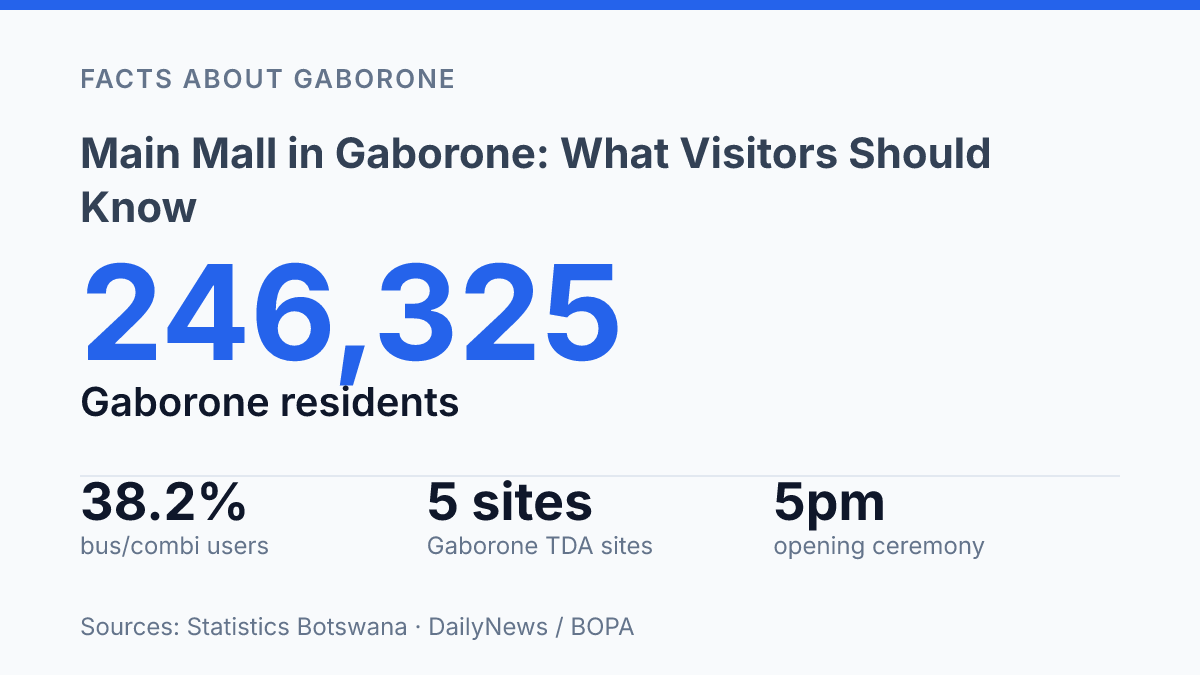
Gaborone is shaped by movement: 38.2% of residents use buses or combis as their main transport. In my honest opinion, if you read the street as infrastructure, not décor, it starts to make sense.
Why Main Mall isn’t a shopping centre
The quickest way to misunderstand Main Mall is to arrive expecting air-conditioning, escalators. A roof.
This is not an enclosed shopping centre. It’s a pedestrianised commercial strip running through the city centre of Gaborone, Botswana’s capital.
The name sounds modern and generic. The place works more like a civic corridor than a consumer mall.
A 2023 architectural study from AIJ / J-STAGE describes it as a 1960s pedestrian mall, with its spatial organisation compared to Rotterdam’s Lijnbaan. That comparison matters because it points to planning, movement, and public space, not just shopping.
Walk through at the right hour and the rhythm comes from people with somewhere to be. Office workers cross it between errands.
Government employees move through from nearby administrative areas. Street traders fill the gaps with food, small goods, and face-to-face sales.
That mix changes how you should read the place. You’re not entering a controlled retail box where everything is designed to keep you browsing. You’re stepping into a working part of the capital, shaped by weekday routines, short stops, and public life.
Statistics Botswana counted 246,325 residents in Gaborone City in the 2022 census. The centre feels less like a residential neighbourhood than a daytime meeting point. In my view, that’s why treating it as “just a mall” misses the point. Its value is in the overlap: commerce, administration, commuting, and informal trade all sharing the same open pedestrian spine.
What the street looks and feels like
The first thing you notice is how little the street tries to impress you. The buildings sit low and broad, with concrete faces, shaded shopfronts, and practical overhangs that do more work than decoration. There’s no glossy arrival moment. In my honest opinion, the plainness is part of the point.
Most buildings along the strip feel civic before they feel commercial. Their proportions are modest.
The signage can look patched together from different decades. Near Botswana Book Centre, that mix becomes clear: formal facades, small traders, pedestrians, and old concrete all share the same narrow field of view.
Scattered jacaranda trees change the mood more than the architecture does. They don’t turn the street into a garden.
They break up the hard edges and throw pockets of shade across the paving. When the purple flowers drop, the colour sits briefly against the grey concrete before foot traffic and dust flatten it again.
Around lunchtime, the street becomes easier to understand with your nose than your eyes. Grilled boerewors from corner braai stands cuts through the heat, then mixes with exhaust from kombis waiting on nearby streets. According to Statistics Botswana’s June 2025 transport analysis, 38.2% of the population used buses or combis as their main transport mode.
That smell of diesel isn’t background noise. It’s part of how the area works.
Kombis don’t dominate the pedestrian strip itself. They shape its edges. You hear doors sliding, engines idling, conductors calling, and short bursts of traffic as people peel away from the walkway.
The contrast matters: the central path can feel slow. The streets around it keep pressing in.
During May to September, Gaborone’s dry months leave a faint film of dust on shoes, paving, window ledges, and parked cars. That dryness makes the street feel exposed, especially at midday. Still, the smells, tree shade, and movement give the place more character than its plain concrete face suggests.
Who uses it and why that matters
The sharpest clue to the strip’s purpose is the lunchtime queue: clerks with files, traders watching stock, and office staff trying to finish three errands before food goes cold. Civil servants and office workers bring the steady weekday volume. Traders give that volume a reason to pause.
The administrative pull is not accidental. Mmegi reported in 2016 that the corridor was planned in 1963 in preparation for independence, placed between the Civic Centre and the National Assembly. That location still shapes who passes through it, even when the buildings look plain.
Movement feels different here than on the vehicle-heavy streets nearby. You don’t just walk along an edge and wait for a gap in traffic. You cut across, slow down, greet someone, compare prices, queue, then move again.
That freedom has a tradeoff. The place can look spare, even old-fashioned, beside newer commercial areas. But that simplicity is exactly why it still works: there’s room for errands, selling, waiting, and quick conversations without making every action depend on a car door.
Lunchtime is the pressure point. Braai stands draw the longest pauses, and service points pull their own lines as people use the break to pay, print, collect, ask, or repair. If you visit then, you’ll see the corridor acting less like a retail destination and more like a public office lobby stretched outdoors.
The traders are not decoration. DailyNews profiled arts-and-crafts reseller George Molele in 2024 as a long-standing presence there. That kind of continuity matters. In my humble opinion, the traders matter as much as the buildings here, because they make the place legible to regular users.
Transport still frames the edges. The core experience stays on foot. Statistics Botswana’s June 2025 transport analysis found that 23.5% of the population used taxis as their main mode.
That doesn’t turn this into a transport guide. It explains why the pedestrian corridor has to absorb people arriving from busy streets and then let them move at human speed.
What first-time visitors usually miss
The quickest way to misread the place is to arrive looking for glass doors, anchor tenants, and air-conditioning. If you expect a conventional mall, you’ll leave with the wrong impression. It works better as a public street with commerce than as a private retail complex.
What looks underwhelming at first can become more legible once you stop judging it like a shopping stop. People aren’t only there to browse. They pass through, meet someone, buy something small, handle an errand, or pause before moving on.
Midday is the practical test. Stand back for a few minutes then. The pace makes more sense: short conversations, quick purchases, people crossing paths with purpose.
Don’t look for a single main attraction. Watch the movement.
A useful clue is that official planning now treats the area less like a retail property and more like part of the city’s public visitor life. In April 2025, DailyNews / BOPA reported that Botswana had been divided into 8 Tourism Development Areas, with the Gaborone area identifying 5 sites for concept designs, including this corridor.
That doesn’t make it polished overnight. It does show why the place keeps appearing in civic and tourism conversations.
Tourists often want a clean, packaged stop. The real value is different. This is where you see how Gaborone moves through its centre in ordinary time. In my view, the mistake is judging it by retail polish instead of public use.
Read it that way. The confusion fades.
Read the street before you judge the shops
The best way to approach Main Mall is to slow down before you decide what it lacks.
Plans now point toward a more curated future. On 23 August 2024, Parliament listed a motion to place the area inside a creative-sector Special Economic Zone.
That could bring sharper programming and better visitor facilities. It could also sand down the rough edges that give the street its memory.
That tension matters. A city of 246,325 people needs places that work for office staff at lunch, traders at pavement level, and visitors with no local script. George Molele selling crafts there since the 1960s says more than any signboard can.
In my humble opinion, Don’t just look for attractions here. Watch who the street still belongs to.
Frequently Asked Questions
Q: Is Main Mall in Gaborone an actual shopping mall?
A: No. It’s a pedestrianised commercial strip in the centre of Gaborone, not a sealed shopping centre with anchor stores and food courts. That surprises first-time visitors, but it’s exactly why the place feels more like a working city street than a retail complex.
Q: What can you buy or do there?
A: You’ll find offices, small shops, street traders, and places to grab lunch. The mix changes through the day. It feels busy at midday and more practical than touristy. In my view, that’s the real appeal… it’s a place to see how the city actually moves.
Q: What does the area feel like on a normal day?
A: It has a steady, no-nonsense rhythm. Office workers, government employees, and traders all share the same space. The atmosphere shifts fast around lunch. You might catch grilled boerewors from a braai stand, then turn a corner and smell diesel from idling kombis.
Q: Is Main Mall easy to walk around?
A: Yes, it’s built for pedestrians, so walking is the point. The low-slung concrete buildings and scattered jacaranda trees make it simple to move through. The streets around it can feel more chaotic. That contrast is part of the experience.
Q: When is the best time to visit Main Mall?
A: Late morning to lunchtime is the best window if you want the full scene. That’s when the street traders, workers, and food stalls create the strongest energy. If you go later, it’s quieter, but you’ll miss the midday buzz.