
Airport Junction Shopping Centre pairs more than 100 tenants with a rooftop solar plant large enough to save about 3,500 MWh a year. That’s not the usual mall fact people expect. It explains why this Gaborone centre deserves a closer look.
The name is literal. Airport Road encloses its south side, the A1 runs along its eastern flank, and Plot 70665 in Block 10 puts it on a road junction with real commercial logic.
Officially opened on 26 April 2012, the P469 million development was built at a scale that still shapes how people shop, eat, bank, repair, and run errands in one stop. This guide pins down the location, the build, the retail space. The details that separate Airport Junction from smaller centres. In my view, the solar story makes the place more interesting than its floor area alone.
Where the mall sits on Airport Road and the A1
The name is almost a map label: Airport Junction Shopping Centre sits where Airport Road meets the A1 in Gaborone, Botswana. That placement does most of the explaining before you even look at a store directory. It puts the centre on the city’s airport-side route and beside the main highway connection, not tucked deep inside a residential pocket.
Opening date and the scale of the build
A P469 million mall opening in 2012 was not a corner-shop bet. It was a public statement about how big formal retail could become in Gaborone. The centre opened in April 2012, with the official opening recorded on 26 April 2012 by Botswana Insurance Holdings Limited in its 2011/2012 annual report.
That price tag matters because it places the project in a different category from a convenience centre built to serve only nearby households. A development of that cost needs broad pull. It has to attract repeat visits, absorb high operating demands, and justify itself through more than novelty.
The ambition was clear from the way the project was framed. BIHL described it as a fully enclosed retail development, not a loose strip of shops or a modest local complex.
That distinction matters. Enclosed malls require heavier spending on shared interiors, climate control, circulation space, security, and long-term maintenance.
But money alone doesn’t make a centre durable. Plenty of large retail projects open with noise, then fade when shopper habits move on. The sharper question is whether the investment created a place people kept using after the launch excitement passed.
In my view, the build cost is the most revealing fact here because it shows intent before performance. The developers weren’t testing a small site.
They were backing a large urban retail project with enough capital to compete for attention across the city. That level of commitment set expectations high from day one… and gave the mall very little room to feel ordinary.
How much retail space it offers
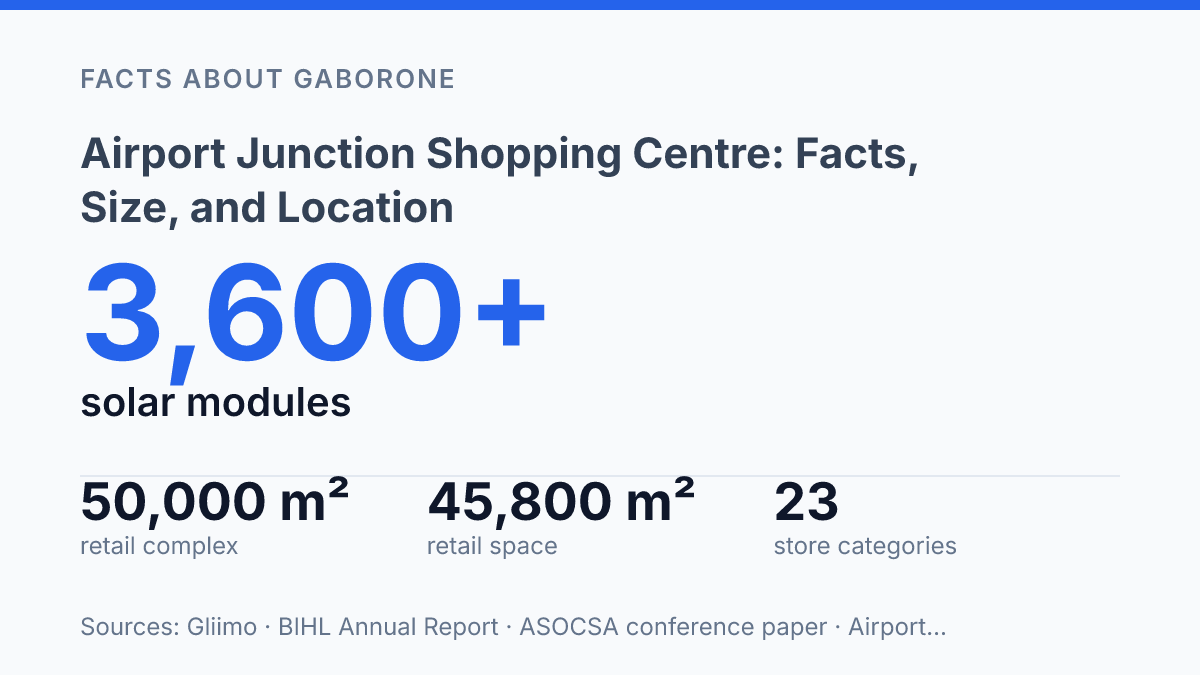
At 45,800 square metres of retail space, Airport Junction has enough floor area to behave less like a quick stop and more like a planned errand circuit. That figure comes from an ASOCSA conference paper published in 2024/posted 2025, which also lists the wider site at 51,145 square metres. The difference matters.
Most of the property is not dead space. It is built around retail use.
That scale places the centre among the three largest shopping centres in Gaborone. For shoppers, that usually means a wider mix under one roof: grocery anchors, clothing stores, food options, banking, telecoms, pharmacies, home goods, and daily services.
You don’t visit a centre this size only to browse. You go there to finish several tasks in one trip.
Large-format retail has a clear advantage. It comes with a tradeoff. More floor area can mean more choice.
It can also make the experience feel spread out if the route between stores is poor. A big centre has to earn its size through clear circulation, strong anchor placement, and enough useful tenants to make the walking feel worthwhile.
The reported tenant depth supports that larger role. The same ASOCSA paper says the centre has over 100 tenants. The official store directory groups shops and services into 23 categories. In my honest opinion, that category range matters more than the raw square metre count, because shoppers remember whether they solved their errands, not the size printed in a report.
Compared with smaller neighbourhood centres in the city, this footprint gives Airport Junction a different function. It isn’t just serving people who need milk, airtime, or a fast meal. It is built for longer visits, cross-shopping, and trips where convenience depends on having enough options in one place.
Why Airport Junction stands out in Gaborone retail
The real differentiator is geography: Airport Junction grew big outside the city’s retail core, not inside it.
When the centre opened in 2012, its P469 million cost and 45,800 square metres of retail space put it in the same conversation as Gaborone’s biggest malls. That scale matters. It made the project more than a convenient neighbourhood stop, but size alone doesn’t explain why people remember it.
In 2014, Construction Review Online reported that the P469 million mall is enclosed on the south side by Airport Road and adjacent to the A1 on the east flank. That road-facing identity gives the centre a different role from malls buried deeper in the city. You understand its positioning before you even enter the building.
Among Gaborone’s three largest shopping centres, it stands out less as the most central option and more as the airport-side alternative. That distinction matters for northern suburbs, airport-area movement, and drivers using the A1 corridor.
More centrally placed malls may suit quick inner-city errands better. This one has a clearer edge as a landmark on a major approach route.
The centre also has a less visible point of difference. Gliimo reported a 2.2 MWp rooftop solar installation with over 3,600 modules, producing around 3,500 MWh a year, and described it as Botswana’s largest rooftop solar project. That gives the property an infrastructure story, not just a retail one.
Still, its biggest strength is also its limitation. A mall known for scale and location can make people expect more than its tenant mix, parking flow, or internal layout always delivers. In my humble opinion, its importance in Gaborone retail is clearest when you judge it as a strategic property, not just a place to browse.
What the junction tells you before you park
The smart way to read this mall is as infrastructure, not just retail. Its next chapter will depend less on adding shops and more on how well Khumo Property Asset Management keeps the mix useful for daily life: groceries, repairs, banking, meals, and power that cuts operating pressure.
The harder truth is that size can age badly. A centre can be large and still feel thin if tenants repeat each other. The solar push reported on 3 May 2022, including plans for 100 solar lamps for Gakgatla learners, gives Airport Junction a sharper identity. In my honest opinion, that’s the standard other Gaborone malls should be measured against.
If you visit, don’t just count storefronts. Watch what problems the place solves in one trip.
Frequently Asked Questions
Q: Where is Airport Junction Shopping Centre located?
A: It sits at the meeting point of Airport Road and the A1 in Gaborone, Botswana. That location matters because it’s easy to reach from key parts of the city. It also means traffic can build up around busy hours. If you’re planning a visit, timing helps.
Q: When did Airport Junction Shopping Centre open?
A: It opened in April 2012. That gives it a solid track record, not a brand-new feel that still needs proving. In my humble opinion, that maturity is part of why people treat it as a major retail stop rather than just another mall.
Q: How big is Airport Junction Shopping Centre?
A: The centre has 45,800 square metres of retail space. That puts it among the three largest shopping centres in Gaborone, so you’re dealing with a serious retail footprint, not a small neighborhood strip. Size helps here. It also means you’ll want to allow extra time.
Q: How much did Airport Junction Shopping Centre cost to build?
A: It cost 469 million Botswana pula to build. That figure shows the scale of the project. It explains why the centre stands out in Gaborone’s retail market. Big budgets don’t guarantee success. They do signal ambition.
Q: Is Airport Junction Shopping Centre one of the biggest malls in Gaborone?
A: Yes, it ranks as one of the three largest shopping centres in Gaborone. That doesn’t automatically make it the most convenient for every shopper. It does make it one of the city’s main retail anchors. If you want a major mall with broad scale, this is one of the top names to know.