
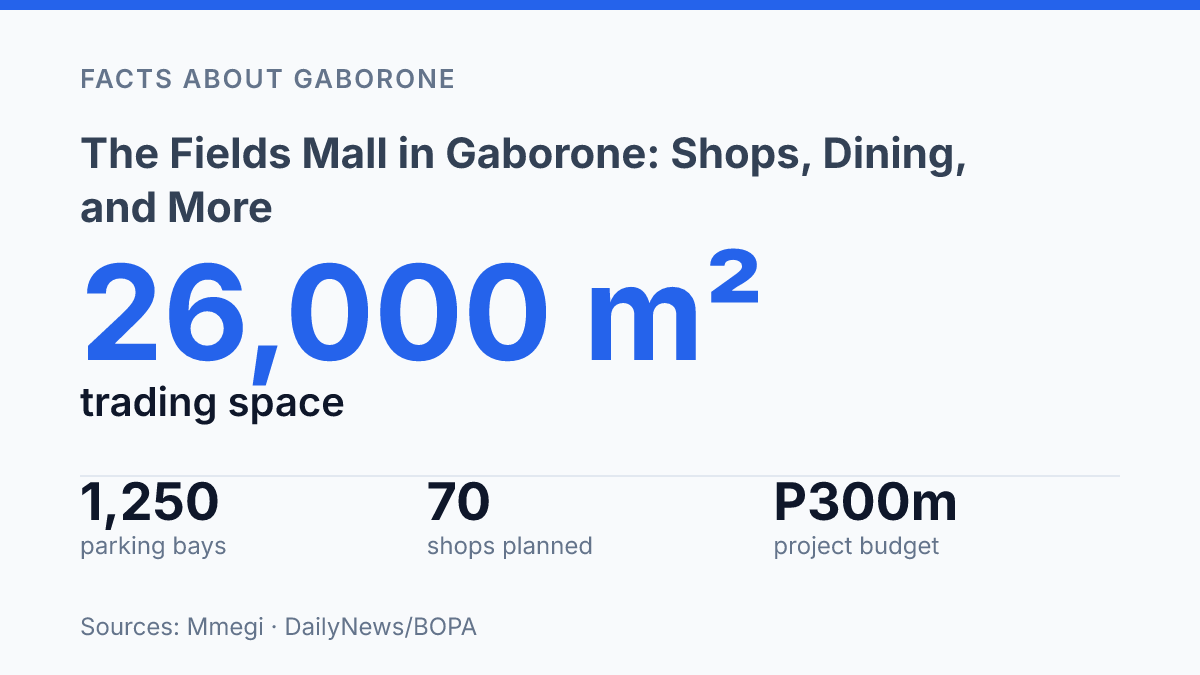
The Fields Mall gave Gaborone’s CBD 26,000 m² of trading space in a single day on 28 July 2022. The sharper story is who built it.
Backed through Smart Partnership Enterprises by more than 100 Batswana citizens, this wasn’t just another retail block copied from somewhere else. In my honest opinion, that local ownership changes how the mall should be judged.
Yes, you’ll find Spar, Pick n Pay, Woolworths, Edgars, Clicks, Dis-Chem, Doppio Zero, and Chicken Licken. That part is easy.
The more useful question is how a mall with 1,250 parking bays, planned pedestrian links, sports courts, property expos, and motor-show crowds starts to behave like part of the city’s daily operating system. That’s where the story gets more interesting.
What changed when The Fields Mall opened
One mall opening changed the CBD’s social map faster than its tenant mix could explain.
For readers who have seen 2015 attached to earlier project timelines, the customer-facing milestone came later: according to Mmegi, the Fields Mall opened to customers on 28 July 2022 with 26,000 m² of trading space in the CBD. That detail matters. It places the mall inside the daily flow of the city centre, not on the edge of town where visits feel more planned.
In Gaborone, location does a lot of the work. A central address makes it easier for office workers, families, students, and weekend visitors to overlap in the same place. The result is less like a pure shopping trip and more like a public meeting point with tills nearby.
Behind the address sat the P4 billion investment tied to the development. That scale changed expectations before the first weekend crowds arrived.
Large capital can make a place feel cold. This one quickly took on a more ordinary job: giving people a shared reference point.
That’s the real change. The mall was built as a shopping project, but its bigger value is social. People go there to meet before dinner, wait between errands, take children out, or settle plans when no one wants to choose a formal venue.
In my view, that social shift matters more than the shopfront count. Retail brought people through the doors, but habit made the place stick.
What you can actually do there
A full visit can start with a grocery run and end with a late movie. That range is exactly why people don’t treat the mall as a quick errand stop.
Its 41,000 square metres of retail space gives it enough scale for planned shopping, impulse spending. The kind of “let’s just look around” visit that turns into two hours.
The retail mix does the practical work first. With more than 100 stores across fashion, tech, beauty, home goods, and daily needs, you can replace a charger, buy work clothes, pick up toiletries, and sort out a small gift without crossing town. That matters in Gaborone, where one-stop convenience can save half a day.
Shopping is the obvious draw, but the cinema and food court do a lot of the heavy lifting. They keep people there longer. A family can split up between errands and a meal, teenagers can meet without needing a formal plan, and office workers can turn lunch into a social break rather than a rushed takeaway.
The food options also soften the pace of the place. You don’t have to commit to a full restaurant sit-down if you’re only passing through.
You can still make the visit feel less transactional. That’s the quiet trick: dining turns a shopping centre into somewhere people linger.
Entertainment adds the same pull in a different way. A cinema gives the mall an evening purpose, not just a daytime one. In my honest opinion, that’s what separates a useful retail centre from a place that actually holds people’s attention.
The tradeoff is that a broader mix can make peak times feel crowded. More reasons to visit mean more overlapping crowds: shoppers, diners, moviegoers, parents, students, and people who are simply waiting for someone else.
Still, that overlap is also the point. The mall works because it gives different people different reasons to stay in the same place.
How it fits into everyday life in the city
One hour of free parking may do more for daily habits than any glossy shopfront. DailyNews/BOPA reported about 1,250 parking bays at The Fields, split between roughly 650 above ground and 600 in the basement.
That detail sounds mundane. It changes how people use the place.
In Botswana, urban retail habits are becoming more routine and less occasion-based. People don’t only go out to “shop” anymore. They meet someone after work, collect what they need, grab a quick meal, and get back on the road before the evening disappears.
The mall looks polished, but its real function is practical. It saves time for people who want shops, food, and errands in one stop. In my humble opinion, that convenience matters more than the polished finish.
Its position in central Gaborone makes that routine easier. Office workers can pass through after work without planning a full outing. Friends can choose it as a neutral meeting point because everyone knows where it is, and no one has to explain the directions twice.
The pattern changes again when weekend traffic builds. A quick stop can turn into a longer stay, not because the mall forces it, but because families and groups tend to layer plans once they’re already there. That’s useful, though it also means the easiest time to visit isn’t always the most relaxed time.
Access matters too. DailyNews/BOPA noted work on walkways between The Fields and Rail Park Mall, including a pedestrian tunnel under the overpass and a planned taxi drop-off area. Those links make the centre less dependent on private cars, even though parking remains a major part of its appeal.
Why it matters beyond retail
The most revealing number attached to the project isn’t floor space. It’s roughly 2,000 jobs tied to getting the centre built, opened, serviced, secured, stocked, cleaned, and managed. That makes the development part of Gaborone’s employment story, not just its consumer story.
Jobs like these aren’t abstract. They sit in households, transport routes, supplier contracts, and daily wages.
Seen from that angle, the 2015 opening works as a marker of a city trying to build more than offices and roads. It showed confidence in the CBD as a place where private capital, public movement, and everyday life could overlap.
The project was also planned as a P300 million development backed by more than 100 Batswana citizens through Smart Partnership Enterprises, according to DailyNews/BOPA. That local ownership detail matters. In my view, it’s the part that makes the mall feel less like an imported retail box and more like a Gaborone development with local stakes.
There is a real tradeoff here. Big malls can pull spending away from smaller shops, especially when they offer easier parking, longer hours. A stronger mix of services under one roof.
Pretending otherwise would be dishonest. But they can also create a wider commercial pull… and that split is part of the story here.
That wider pull helps nearby businesses in practical ways. More people moving through the CBD means more demand for taxis, cleaning services, security firms, couriers, informal traders, office services, and small operators around the centre.
Some benefit directly through contracts. Others benefit because the area stays active for longer parts of the day.
The civic role is just as important. Events linked to sport, property, and motoring have used the centre as a public platform, drawing people who aren’t there for ordinary retail errands. That matters because cities need shared places that can hold different kinds of activity.
A mall won’t solve every urban problem. This one has become part of how Gaborone gathers, spends, works, and gets noticed.
When a shopping centre starts shaping city habits
A mall becomes more than a mall when people start using it for reasons nobody can fit on a store directory.
The clearest signal came when First Capital Bank Sports Village opened in August 2023. By mid-2024, its padel courts carried a waiting list of up to four weeks.
That’s not casual foot traffic. That’s habit formation.
The risk is that success turns the place into another car-first island. The opportunity is better. If the walkways, taxi access, and event programming keep improving, The Fields can pull more life into the CBD instead of just pulling wallets into shops. In my humble opinion, that’s the real measure of the project now: not how much it sells, but how often Gaborone chooses to gather there.
Frequently Asked Questions
Q: What stores are in The Fields Mall in Gaborone?
A: The Fields Mall has a mix of fashion, lifestyle, and everyday retail stores. You’ll find the usual shopping basics there. The exact tenant list can change, so it’s smart to check before you go. In my view, that flexibility is part of the appeal… you’re not locked into one kind of shopping trip.
Q: Does The Fields Mall have restaurants and cafés?
A: Yes, dining is a big part of the experience at The Fields Mall. You can grab a quick coffee, sit down for a meal, or meet friends for something casual. The mix matters because it turns a simple errand into a place to linger.
Q: Is The Fields Mall good for families?
A: Yes, it works well for families because there’s more to do than shop. The mall is set up for eating, meeting, and spending time together, which helps when you’ve got kids in tow. The convenience is the point. It never feels like a one-note stop.
Q: Where is The Fields Mall located in Gaborone?
A: The Fields Mall is in Gaborone, in a spot that’s easy to reach for a city shopping run. If you’re planning a visit, check your route ahead of time so you don’t waste time circling for parking or missing your turn. That small bit of planning makes the whole trip smoother.
Q: Why do people go to The Fields Mall instead of other shopping centres?
A: People go because The Fields Mall is built for more than retail. It’s a place to shop, eat, play, and connect, which gives it more range than a basic strip of stores. 2014 marked a major shift for Gaborone’s retail scene; The Fields Mall stands out for bringing people together; 1 visit can cover shopping, dining, and downtime in one stop.