
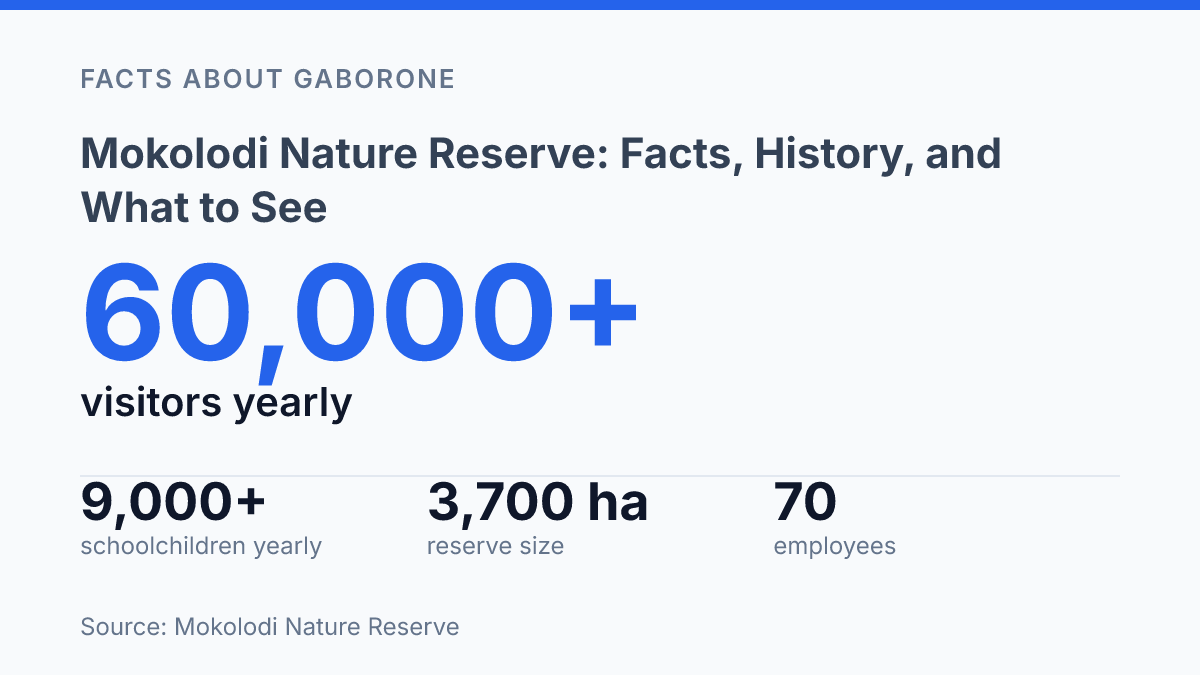
Mokolodi Nature Reserve pulls more than 60,000 visitors a year into bushveld that was cattle land in 1994, yet its real reach starts in classrooms. That contrast matters.
The reserve sits only about 10 to 14 kilometres south of Gaborone, close enough for a half-day escape. It works like something much bigger than a picnic stop.
Its 3,700 hectares hold game drives, mountain-bike trails, night safaris, and rhino conservation stories that visitors remember. But the sharper story is the one behind the gates: donated land turned into a local employer, an education centre for thousands of children. A practical answer to the question of what conservation should do for a city. In my honest opinion, the best way to understand Mokolodi is not as a small safari add-on, but as Gaborone’s outdoor classroom with wildlife in the margins.
Why Mokolodi matters to Gaborone visitors
Few African capitals put donated bushveld within a short drive of office blocks, malls, and airport-bound schedules. Mokolodi Nature Reserve sits 10 kilometres south of Gaborone, close enough for a morning or afternoon outing rather than a full safari detour.
The Mokolodi Nature Reserve official site describes it as established in 1994 on 3,700 hectares of donated bushveld formerly used for cattle farming; The Mokolodi Wildlife Foundation was the organisation behind that shift. That origin matters.
This isn’t a roadside animal park tacked onto the capital. It began as a protected place with a conservation purpose.
Visitor guides often round the reserve to 30 square kilometres. That scale shapes the experience.
It’s large enough to feel like real bush once you’re inside the gates. It’s also contained enough that short-stay travellers don’t have to choose between seeing wildlife and keeping a tight city itinerary.
That closeness creates the reserve’s main tension. You can reach it from urban Gaborone with little effort.
The mood changes fast once the road gives way to managed habitat. The place still runs on rules, boundaries, and wildlife-first thinking. In my view, that contrast is the whole reason it matters to visitors.
Its audience is broader than tourists with cameras. The reserve reports about 70 employees and more than 60,000 visitors a year, which makes it a local institution as much as a leisure stop.
For Gaborone residents, it’s a reachable patch of protected bush. For first-time visitors, it’s the easiest way to understand how close Botswana’s capital sits to wild country without leaving the capital region behind.
What the reserve was built to do
A gate fee here is not just a ticket. It helps fund a conservation project with classrooms, staff, fences, water systems, and long-term land care behind it. The founding body, The Mokolodi Wildlife Foundation, set it up as a private not-for-profit game reserve in southern Botswana, so income is meant to go back into the reserve’s mission rather than into shareholder returns.
That sounds dry on paper. It’s the detail that explains almost everything about how the place works.
That ownership model can mislead first-time visitors. “Private” can sound closed, expensive, or built for a narrow market.
The not-for-profit structure pulls the reserve toward public value. In my honest opinion, this is the most important distinction in understanding Mokolodi: it isn’t only selling wildlife experiences. It’s using those experiences to pay for conservation access, local jobs, and environmental education.
Donated land changed the whole equation. Land given for conservation starts with a different pressure than land bought for quick commercial return.
It gives managers room to think in decades, not seasons. It protects a site close enough for schools, families, researchers, and local residents to use without turning every visit into a major expedition.
Education gives the model its clearest proof. According to the reserve’s official site in 2026, more than 9,000 schoolchildren visit its Education Centre each year, turning the property into more than a wildlife enclosure. The tradeoff is real, though: public-minded conservation still has bills to pay.
Roads wash out, animals need care, fences need maintenance, and staff need salaries. The reserve’s structure doesn’t remove those costs. It gives every paid visit a wider purpose.
Best-known activities and wildlife encounters
A two-hour outing here can fit rhino viewing, plains game. A night drive into a schedule that would be impossible in a vast wilderness park.
The standard choice is a guided game drive, usually in an open vehicle, with a guide reading tracks, scanning shade, and explaining animal behaviour as you move through the reserve. SafariBookings’ 2026 guide lists day and night game drives of about two hours, plus self-drive access for visitors who want a looser pace.
Wildlife sightings tend to be close and practical rather than cinematic. You’re more likely to spend time with giraffe, zebra, kudu, impala, warthog, ostrich, and other adaptable bushveld species than wait all day for a distant predator.
That suits families well. Children don’t have to sit through long empty stretches before something moves.
The headline conservation encounter is white rhino viewing. According to the Botswana Tourism Organisation, the reserve’s white rhino population had reached eight through reintroduction and breeding as of 2021.
That number may have changed, so treat it as a dated snapshot, not a live count. Still, it shows why guided viewing matters here: the experience connects tourism with managed protection, not just animal spotting.
Close-up encounters can also include activity around education facilities, reptile displays, or guided walks when offered. These are controlled experiences, not a promise of touching wild animals.
That distinction matters. Good wildlife tourism creates proximity without turning animals into props.
Its compact scale is the real advantage, but also the limit. You can see a lot without losing a whole day, and guides don’t need to cover huge distances to find signs of life.
The flip side is obvious once you’ve been to larger parks: the drama feels tighter. There’s less wilderness sweep, less suspense, and fewer moments where the horizon itself feels wild.
Mountain biking gives the reserve another angle for active visitors. SafariBookings notes three designated trails, which makes the place useful even if not everyone in your group wants a vehicle-based outing. In my humble opinion, that mix is the reserve’s strongest visitor asset: it’s not trying to outdo Botswana’s great wilderness areas. It works because it gives you credible wildlife access in a compact, manageable format.
How to plan a visit from the capital
You can leave central Gaborone after breakfast and still be back before lunch, but only if you treat Mokolodi like a booked activity rather than a roadside stop. For most visitors, the practical drive is around 20 to 30 minutes, depending on traffic and where you start in the city.
The reserve sits south of the capital. It works best when you plan it as a focused outing instead of trying to squeeze it between several cross-town stops.
Access is straightforward by car, and Botswana Tourism describes the approach via Lobatse Road. That matters if you’re using a taxi, ride arrangement, or hotel transfer.
Give the driver the reserve name and confirm the return plan before you enter. You don’t want to finish a late activity and start negotiating transport from the gate.
A half-day visit suits travellers who want one main nature activity, a relaxed meal stop. A break from the city. It also works well for families with younger children.
Keep the plan simple. One scheduled activity is enough if you don’t want tired kids, missed meals, or a rushed exit.
Choose a full-day visit if you want more time between activities or you’re travelling with people who move slowly. You’ll have more room for delays, heat breaks, and quiet pauses. In my view, the mistake is assuming proximity means speed. Wildlife time rarely rewards rushing.
Families should check current opening hours, booking rules, food options, and age limits before setting out. Bring water, sun protection, and patience. The dry-season months of April to October are recommended by SafariBookings for visiting, but clearer conditions can also mean busier weekends and school-holiday pressure.
School groups need more structure than casual visitors. Organisers should confirm arrival times, group size, supervision, meals, and any education programme requirements in advance. For short nature breaks, the reserve is easy to justify.
It’s close enough for a morning escape. The best visits still respect the clock, the weather. The pace of the bush.
What the reserve asks of visitors next
## What the reserve asks of visitors next
The next smart move isn’t just booking a drive. It’s deciding what kind of visit you want to support. On September 2, 2024, Mokgweetsi Masisi tied the reserve’s anniversary to fundraising for children’s camps.
That detail changes the lens. Your ticket isn’t only buying access to animals. It helps keep a public education machine running.
Plan for more than sightings. Ask about the Education Centre. Check current rhino information before you repeat old numbers.
Leave room for a guided drive if you want context, not just photos. The reserve reaches more than 10,000 young Batswana in some years, but visitors still shape its future. In my humble opinion, the measure of a good trip here is what you notice after the animals move out of frame.
Frequently Asked Questions
Q: Where is Mokolodi Nature Reserve located?
A: It sits about 10 kilometres south of Gaborone in southern Botswana. The reserve covers 30 square kilometres of donated land, so it’s close to the city but still feels properly separated from it. That contrast is a big part of the appeal.
Q: Who founded Mokolodi Nature Reserve?
A: The reserve was founded in 1994 by The Mokolodi Wildlife Foundation. That date matters because it makes the reserve relatively young, but its conservation role is already well established. In my view, that gives it a focused, practical identity rather than a dusty historical one.
Q: Is Mokolodi Nature Reserve private or public?
A: It’s a private not-for-profit game reserve. That setup means the reserve is run for conservation and education rather than profit, which changes how the place operates. You get a different feel from a state-run park.
Q: How big is Mokolodi Nature Reserve?
A: The reserve covers 30 square kilometres. That’s large enough to support wildlife experiences, but compact enough that you can get a strong sense of the place without spending all day in transit. Small doesn’t mean limited here.
Q: What makes Mokolodi Nature Reserve worth visiting?
A: Its strongest draw is the mix of wildlife, conservation work, and easy access from Gaborone. You’re close to the capital. The reserve still gives you a clear break from city noise. That balance is the whole point.