
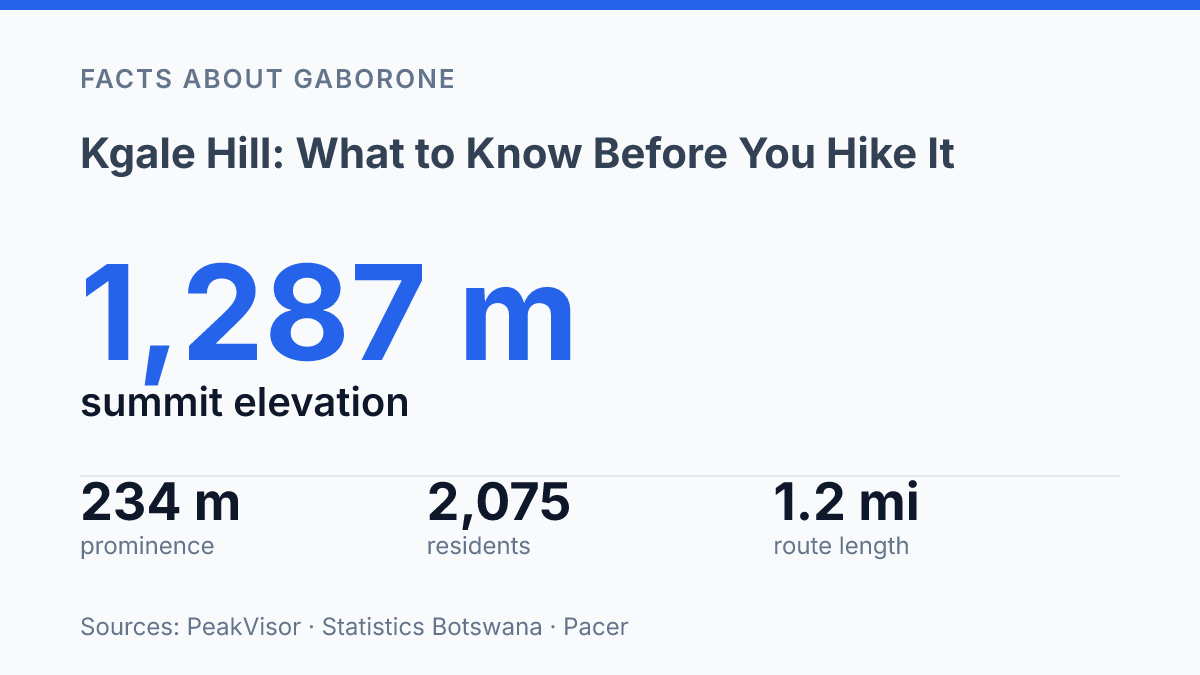
Kgale Hill isn’t a remote wilderness escape. It rises to 1,287 metres inside Gaborone‘s orbit, close enough to reach from the CBD in about 15 minutes. That contrast is the hook.
One minute you’re near malls, traffic, and suburbs. Soon after, you’re on a granite slope locals call The Sleeping Giant, with baboons nearby and the city plain below.
The hill also sits in a real neighbourhood, not outside daily life. In 2022, Kgale Hill Township Extension 1 recorded 2,075 residents, inside a capital city of 246,325 people. In my honest opinion, that makes the hike more interesting than a simple viewpoint. This guide looks at where the hill sits, why its shape matters, how a television repeater site became a visitor stop, and what you’ll actually face when you go.
Where Kgale Hill sits in Gaborone
At 1,287 metres above sea level, the summit is high enough to turn Gaborone’s edge into one of the city’s easiest natural reference points. That figure matters less as a number on paper than as a shape you can pick out from across the capital.
The landmark to look for is Kgale Hill. It sits in Gaborone, Botswana, on the southwestern edge of the capital, where the built-up city starts to loosen into open ground.
On a map, it can look like a modest rise beside the city grid. On the ground, that reading falls apart. Its height gives it a presence that streets, malls, and office blocks can’t match.
The mapping is unusually precise: 24.695502°S, 25.868239°E in Botswana’s South-East District, and PeakVisor records the same summit height, 234 metres of prominence, and rankings of #7 of 26 district peaks by elevation and #2 by prominence. That prominence is the key detail. It explains why the hill stands out even without being a mountain.
In my view, its real value for first-time visitors is orientation. Before you know the neighborhoods or road names, you can still read the skyline by this one raised form on the city’s edge.
Why locals call it The Sleeping Giant
The nickname works because the hill doesn’t rise like a spike. It lies across the skyline like a body at rest. In local conversation and tourist references, Kgale Hill is tied to the name The Sleeping Giant.
The image is easy to see once you stop looking for drama. Its profile is long, low, and heavy-shouldered, with a shape that reads more like a reclining figure than a sharp summit.
That name sounds theatrical. The hill’s pull is quieter than that. The real appeal is visual restraint. From a distance, it can look almost modest, a broad dark form holding its place behind the city.
Stand near it, though. The scale changes fast. The same gentle outline starts to feel massive.
The height helps the nickname stick. At 1,287 metres, the summit gives the landform enough presence to dominate views without looking severe. Evendo describes the nickname as coming from its reclining-person shape and notes that it rises about 300 metres above the city plain.
That extra context matters. A hill doesn’t need a jagged peak to feel imposing.
In my honest opinion, the best part of the nickname is that it doesn’t oversell the place. It asks you to notice shape, weight, and proportion instead of chasing a grand legend. That’s why the name survives: it matches what people actually see.
From television repeater to tourist stop
Before walkers treated the summit as a lookout, its most visible job was sending a signal, not selling a view.
The old television repeater gives the hill a practical past that’s easy to miss. It wasn’t placed there for romance or scenery. It was there because height made it useful.
That detail changes how you read the place. The same exposed position that helped broadcast signals now helps visitors understand the city from above. In my humble opinion, this is the best part of the hill’s story: its appeal didn’t replace its practical value so much as reveal another use for the same shape.
Today, it works as a tourist stop for people visiting Gaborone. Hikers come for the climb, the views. The feeling of reaching a natural marker close to the city.
But the shift is modest, not ceremonial. This isn’t a grand preserved monument with a heavy heritage script attached to it.
Tourism interest also picked up from nearby screen history. A Botswana Press Agency report republished in 2007 says filming for The No. 1 Ladies’ Detective Agency at Kgale View began on July 9, 2007, with a 10-year lease that left set buildings in place after filming. That connection gives some visitors another reason to recognize the area, though the hill’s main draw remains simpler: climb up, look out, and see why a once-technical site became part of the city’s visitor circuit.
What visitors should expect on a visit
The best reason to go isn’t to conquer a peak. It’s to watch Botswana’s capital shrink into roads, roofs, and open ground.
The draw is the climb and the view, plain and simple. From the upper vantage point, Gaborone reads differently than it does from street level.
Ask around and you may hear locals or guides call it The Sleeping Giant, a name that gives the visit more character than a map label ever could. That nickname also sets expectations in the right way.
This isn’t a polished resort attraction. It’s a natural rise that has become part of how visitors read the city.
Practical expectations should stay simple. Botswana Tourism Organisation says the hill has clearly defined routes and that the climb takes about an hour, while UNECA’s 2024 logistics note gives a broader summit time of 1–2 hours and mentions three marked paths. Those figures help you plan the outing without turning it into an over-engineered expedition.
What people sometimes misread is the reward. They expect the summit to be the main event.
The real value sits in the contrast: a quiet slope underfoot, then a full city backdrop opening behind you. That shift is what makes the place worth planning around.
A few nearby reference points also help ground the experience. Botswana Tourism Organisation notes views toward Gaborone Dam and Game City mall.
The panorama isn’t abstract. You can connect what you’re seeing with places people actually use.
In my view, the hill works best when you treat it as a short, focused encounter with the city rather than a box to tick. HELINA’s 2025 conference logistics note puts it about a 15-minute drive from the CBD, which explains why it fits easily into a visit. It feels close to town, but not trapped inside it.
What Kgale Hill asks of first-timers
Treat this hike as a short climb with a long memory. A route that takes 1–2 hours can still expose weak shoes, low water, or poor timing. Go early.
Watch the baboons. Don’t confuse a city-edge trail with a casual stroll.
The stranger layer is what happened around it. Filming for The No. 1 Ladies’ Detective Agency began nearby on July 9, 2007. The set helped turn the area into something visitors recognised before they ever saw the summit. In my humble opinion, that’s the best way to understand the place.
It’s not wild or urban. It’s both. The hill doesn’t let you choose only one.
Frequently Asked Questions
Q: How hard is the Kgale Hill hike?
A: It’s a solid uphill walk, not a casual stroll. The climb pays off fast, but you’ll feel the effort before you reach the top. In my view, that’s exactly why it feels earned instead of crowded with people treating it like a park lap.
Q: How long does it take to hike Kgale Hill?
A: Most people finish it in a few hours, depending on pace and how long they stay at the summit. The route is short enough for a morning outing, but steep enough to slow you down. Bring water and don’t rush it.
Q: What is the elevation of Kgale Hill?
A: Kgale Hill reaches 1,287 metres above sea level. That height gives you a clear sense of why the views feel wide and open from the top. It’s not a mountain by local standards. It still delivers a proper climb.
Q: Why is Kgale Hill called The Sleeping Giant?
A: The nickname comes from the hill’s shape, which resembles a giant lying down. That image stuck. It fits the profile well. The name adds character. The real draw is still the hike itself.
Q: Was there a TV mast on Kgale Hill?
A: Yes. Kgale Hill used to host a television repeater. That past gives the site a different feel from a pure nature walk. Now it’s a tourist destination. You get a place with history and a clear visitor appeal…