
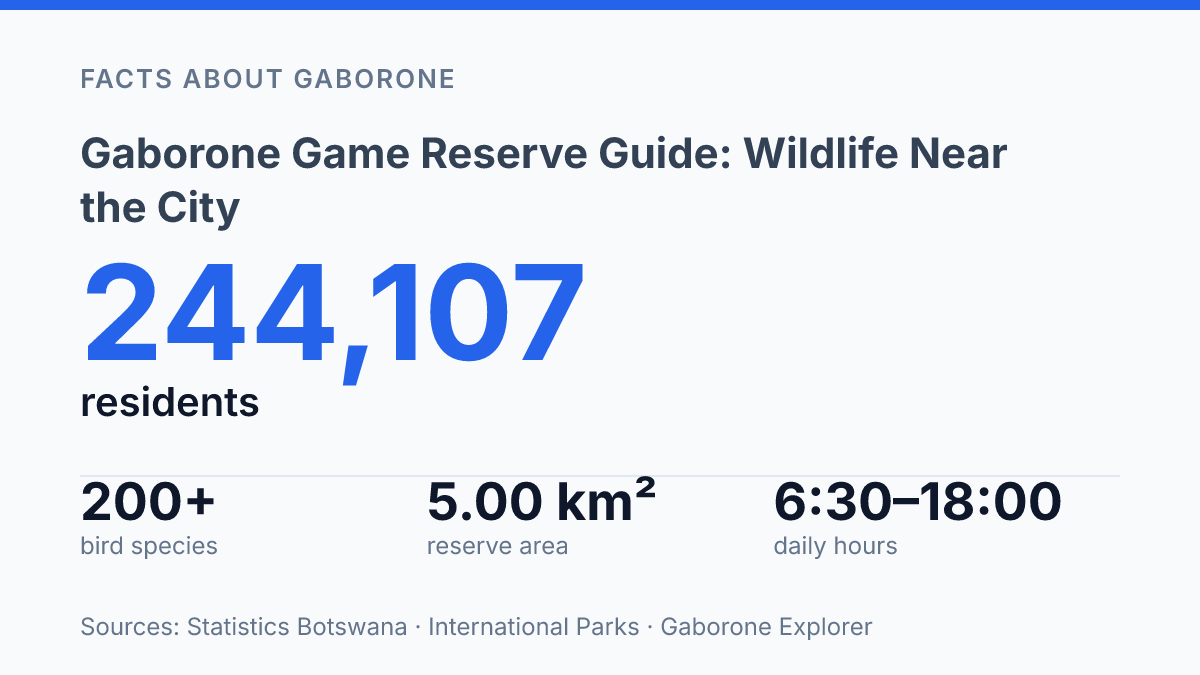
Gaborone Game Reserve covers just 5.00 km². It sits beside a capital city that counted 244,107 residents in 2022.
That contrast is the point. This isn’t a remote safari fantasy sold with endless horizons.
It’s a government wildlife and educational park on the city’s edge, built for access, learning, and quick encounters with real animals. You might see warthogs, impala, kudu, zebra, vervet monkeys, or a steenbok that vanishes before you lift your camera. The birding pulls real weight too, with more than 200 species recorded.
The tradeoff is clear. You won’t get the scale of the Okavango.
You can self-drive a simple loop in under an hour and still feel the city fall away. In my honest opinion, that smallness is not a flaw. It’s the whole reason this reserve works.
Why this reserve matters beside Botswana’s capital
Few African capital cities let you move from office blocks to protected bushveld in the same short outing, but Gaborone does exactly that. The reserve sits near Botswana’s capital in South-East District, close enough to feel like part of the city’s edge rather than a far-off safari destination.
That location is the whole point. This is not a remote wilderness park where distance creates drama before you even arrive.
It’s a protected area near the city centre. That changes the mood of a visit: less expedition, more quick access to nature.
Its scale makes that convenience possible. Statistics Botswana, Selected Environmental Indicators lists the Gaborone Wildlife Educational Park as 5.00 km² of mixed bushveld set aside for urban environmental education. That figure matters because it explains both the appeal and the limit.
You can fit a visit into a morning, an afternoon, or a family outing without building a whole trip around it. For residents, school groups, and travellers short on time, that’s a real advantage. In my view, the reserve matters most because it makes conservation visible to people who might not reach Botswana’s bigger protected areas.
There’s a tradeoff, though. A compact reserve beside a city can’t deliver the same sense of scale, silence, or distance as the country’s larger parks.
Gaborone had 244,107 residents in the 2022 census. The reserve sits next to a major urban population, not beyond it.
That closeness can surprise visitors who arrive expecting deep wilderness. You may still get a rewarding nature break. The setting stays honest: this is city-side conservation, not a days-long safari escape.
Animals and birdlife you can expect to see
You can see six mammal groups before lunch here. The real payoff is that you don’t need a full wilderness expedition to do it.
For large, easy-to-recognise animals, current visitor guidance from She Is Wanderlust in 2026 points to warthogs, impala, kudu, steenbok, zebras and vervet monkeys as realistic sightings. That mix gives a short visit enough movement to stay interesting. Zebra often stand out first, but kudu are the better prize for patient eyes.
Ostrich is the one to treat with care. Some reserve descriptions associate the park with open-country species, but recent visitor guidance is clearer on antelope, warthogs, monkeys and zebras than on ostrich sightings. Ask at the gate or check any recent sightings notes before you set expectations around them.
The compact setting shapes the experience. You may trade the sweep and unpredictability of a major park for something more contained. That isn’t a flaw if your goal is a clean, realistic wildlife stop. In my honest opinion, the best way to enjoy this reserve is to stop measuring it against Botswana’s famous wilderness areas and judge it by how much it can show in a short, low-effort visit.
Birdlife gives the place extra weight. International Parks reports over 200 bird species recorded in the reserve, which is a strong number for such a modest patch of protected bush. Birdwatchers should watch for recognisable southern African species logged by local observers, including lilac-breasted roller, African grey hornbill, red-billed spurfowl and crimson-breasted shrike.
Small reserves reward slower looking. Scan fence lines, open patches, thickets and water edges rather than driving straight through.
The mammals are the easy hook. The birds often make the visit feel richer than the map suggests.
How self-drive visits work
The whole visit can take less time than a long lunch if you drive the main loop without lingering. Recent visitor guidance from She Is Wanderlust says the reserve is set up for self-drive trips, with one main circuit that can be completed in under 1 hour.
That makes it easy to fit around meetings, flights, or a spare morning. It also means you won’t have a guide managing timing, route choice, or gate details for you.
Arriving in your own vehicle is the normal way to experience the route. You pay at the entrance, follow the internal roads, and move at your own pace. In my humble opinion, this is the reserve’s biggest advantage for independent travellers, as long as they treat it like a planned visit rather than a casual detour.
Published practical details should be checked before you set out, since small urban parks can change gate rules without much warning online. Gaborone Explorer lists entry at P10 per adult, P5 per child and P10 per vehicle, with opening hours of 6:30–18:00 daily. Those figures make the visit unusually low-cost, but don’t rely on old screenshots or second-hand posts if your schedule is tight.
Official educational-park procedures also matter for groups. The Government of Botswana states that Educational Parks applications are aimed at citizens and non-citizens, with school field-trip applications taking 5–15 working days.
That’s a different situation from a simple private visit. It shows why organised groups should not turn up assuming the gate can solve everything on arrival.
Weekend access has had stricter controls before. From May 1, 2016, DailyNews/BOPA reported that Saturday and Sunday afternoon entry required pre-arranged booking, capped at 300 people and 60 cars. Even if rules have changed since then, the lesson is practical: weekends can be managed more tightly than weekdays.
Road logistics are simple, not careless-proof. In dry conditions, a standard car is usually the sensible choice for a short loop, provided you drive slowly and stay on the formed tracks. After rain, ask at the gate about surface conditions before committing, because a quick city-side outing can become awkward fast if you meet mud, standing water, or a closed section.
What to know before you go
The strangest planning detail is not the wildlife or the route. It’s the reserve’s reported size.
As of 2026, some travel listings still describe it as a private game reserve in Botswana and show the area as 0 km². Treat that zero as a data problem, not a physical fact.
The more useful reading is simple: this is a very small protected site with an educational purpose, not a lodge-style private concession. That matters. A “private” label can make travellers expect guided drives, luxury facilities.
A deep-bush safari rhythm. You shouldn’t.
Scale changes everything here. Mokolodi Nature Reserve, another popular option for visitors with limited time, is roughly six times larger if you use the reserve’s accepted five-square-kilometre footprint as the baseline. Chobe National Park is in a different universe, with thousands of square kilometres and a far more serious safari setup.
That comparison isn’t meant to diminish this place. It protects you from booking the wrong experience. If you want big predators, long game drives, remote camps.
The sense of being swallowed by wilderness, look to Botswana’s larger parks and reserves. If you want a low-pressure nature break that doesn’t consume a travel day, the compact scale becomes the selling point.
In my view, the best way to judge this reserve is by convenience, not spectacle. It rewards travellers who arrive with modest expectations and a short window. It disappoints people who measure every stop against the Okavango Delta or Chobe.
Before you go, check the latest access rules with a local source or official contact. Small reserves can change practical details faster than major national parks. Opening arrangements, booking rules, and payment expectations may shift without much notice online.
Plan for a brief, self-contained outing. Bring water, sun protection, and patience for slow sightings.
But don’t build a whole day around it unless you’re pairing it with other plans. The limit is the point: small area, quick visit, easy decision.
Why the city-edge reserve rewards better planning
The gate is the wrong place to discover the rules changed. Past weekend controls from May 1, 2016 capped Saturday and Sunday afternoons at 300 people and 60 cars, which tells you something useful: locals don’t treat this as a minor roadside stop.
Check current hours, fees, and booking rules before you go. If you’re planning a school visit, build in the 5–15 working days tied to Botswana’s Educational Parks programme.
That delay can ruin a neat itinerary. It also protects the place from being treated like a picnic shortcut.
Go with modest safari expectations and sharper attention. In my humble opinion, the reward here is not drama on demand. It is noticing how much wildlife a capital city still has room to keep.
Frequently Asked Questions
Q: Can you do a self-drive safari at Gaborone Game Reserve?
A: Yes. Self-drive safaris are allowed, and that’s the easiest way to explore it on your own schedule. The reserve is small. You won’t need a full day to see it properly.
Q: How far is Gaborone Game Reserve from the city centre?
A: It’s close to Gaborone’s city centre, which is the big draw. You can get a wildlife fix without planning a long transfer… and that makes it a smart stop if your time is tight.
Q: What animals can you see in Gaborone Game Reserve?
A: You can expect a mix of common Botswana wildlife, with the reserve known for its diverse species. The exact sightings change by season and time of day, so early visits usually pay off. That’s the tradeoff: it’s convenient. You still need a bit of patience.
Q: Is Gaborone Game Reserve worth visiting?
A: Yes, if you want a quick wildlife stop near the capital. It’s not a huge safari destination, but that’s the point. It gives you an easy nature break without leaving the city behind. In my view, that convenience is what makes it matter.
Q: Is Gaborone Game Reserve a national park or a private reserve?
A: It’s a private game reserve in Botswana’s South-East District. That means the experience feels more compact and focused than a big national park. The setup works best for short visits, not all-day roaming.