
The University of Botswana did not begin with a donor gala. It began with Batswana giving cash, cattle, grain, and eggs toward a 1 million rand campus fund. That origin still cuts through the clean institutional timeline.
The roots reach back to the University of Basutoland, Bechuanaland and Swaziland in 1964. The modern university was created by Act of Parliament in 1982, then inaugurated on 23 October 1982. But the more revealing story is what came after independence-era ambition met real national demand.
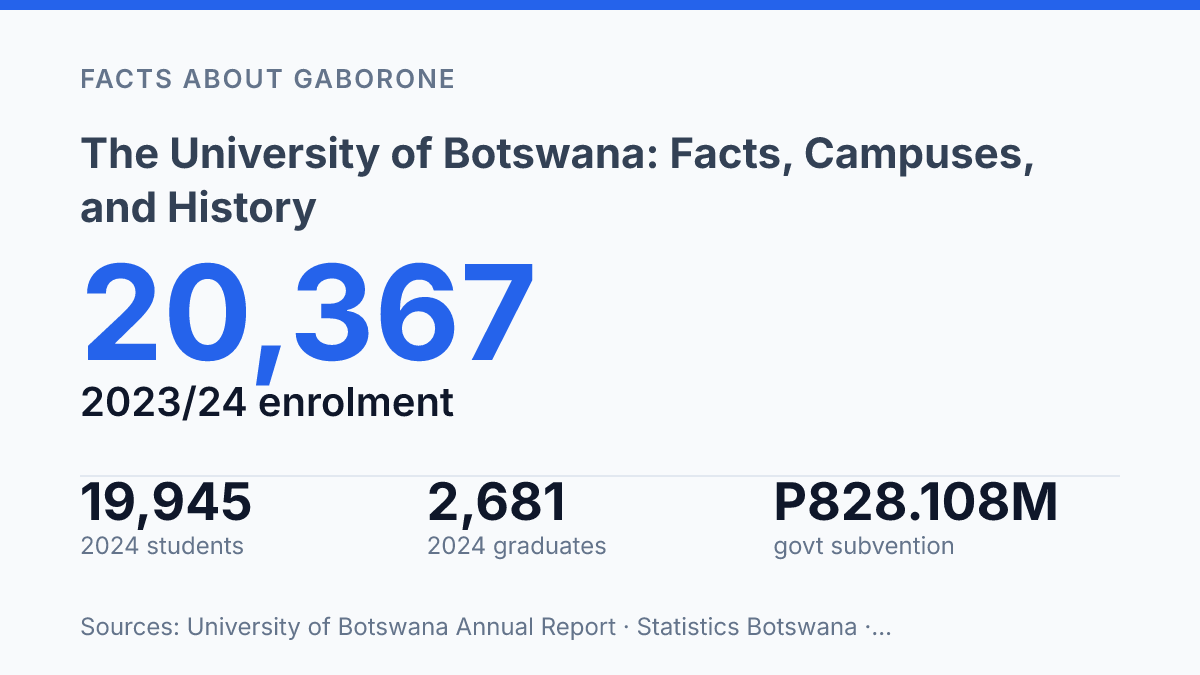
By 2024, UB enrolled 19,945 students, enough to account for 71.9% of public-university enrollment in Botswana. That isn’t just a large campus in Gaborone.
It’s a system with pressure points, satellite campuses, research roles, and public funding choices behind every lecture room. In my honest opinion, the most telling fact isn’t its size. It’s how much of Botswana’s development story now runs through it.
How Botswana’s first university began
Botswana built its first university only after citizens had already helped fund a national campus dream with “cash, cattle, grain, eggs” toward a target of 1 million rand, according to the University of Botswana Discover page, 2019/2024 downloads. That detail matters.
It shows the institution didn’t begin as a distant government project. People had skin in it, sometimes literally from the farmyard.
When The University of Botswana was established in 1982, it became the country’s first institution of higher education. The formal step came by Act of Parliament. The university was inaugurated on 23 October that year, according to its 2023/24 annual report.
The date marked more than administrative independence. It gave Botswana a homegrown academic base at a moment when the country needed trained professionals, teachers, researchers, and public servants.
Before that shift, advanced study often meant leaving the country or depending on regional arrangements. UB traces part of its origin to the University of Basutoland, Bechuanaland and Swaziland, created in 1964.
That regional model made sense for a young education system. It also meant Botswana’s ambitions had to fit inside someone else’s structure.
The first national university arrived late by global standards. The delay sharpened its purpose.
It wasn’t built as a prestige ornament. It was built to reduce dependence. In my view, that is the central point: the university’s timing made its mission clearer, not weaker.
A local university system changed the bargain for students and the state. More Batswana could study closer to home. The government could train talent for national needs instead of hoping graduates would return from abroad.
That didn’t solve every shortage overnight. It moved higher education from aspiration into infrastructure.
The main campus in Gaborone
UB’s most visible address is not tucked away from national power. It sits in Gaborone, where ministries, courts, banks, hospitals, and major employers shape the same daily orbit. That location gives the campus a public face that a remote site simply couldn’t match.
For most students, staff, visitors, and public agencies, the capital campus is the university’s best-known base. Admissions, administration, major ceremonies, student services, and much of the everyday academic traffic pass through this centre. In my honest opinion, that visibility matters because a national university needs to feel reachable, not abstract.
The urban setting gives students more than lecture rooms. It puts them close to internships, transport links, clinics, libraries, government offices, and private-sector workplaces.
A student studying law, education, health, business, or public policy doesn’t have to imagine the country’s institutions from a distance. They’re nearby.
Scale adds weight to that location. UB enrollment rose to 20,367 in 2023/24, according to the University of Botswana Annual Report 2023/24, exceeding the target and reaching the maximum carrying capacity set in the 2008 Campus Master Plan.
That figure isn’t just a headcount. It shows how much pressure the main campus carries every weekday.
But the same capital-city advantage creates friction. Space is tighter, traffic is heavier, and expansion has to compete with the demands of a growing city. The campus gains reach from being in the capital.
It also absorbs the capital’s strain: parking, movement, housing demand. The constant push to make a large institution work inside an urban grid.
That tradeoff is exactly why the Gaborone campus matters so much. It’s both the university’s front door and one of its hardest operational tests.
Francistown and Maun: why three campuses matter
Maun gives the university something a capital base can’t: direct proximity to the Okavango Delta’s environmental and tourism questions. That matters for teaching and research that depend on place, not just lecture rooms. UB’s graduate programme list for 2025/26 places the MPhil in Natural Resource Management at the Maun Campus, tying advanced study to one of Botswana’s most distinctive ecological regions.
The Okavango Research Institute strengthens that local fit. Its listed expertise areas include ecosystem services, ecosystem dynamics, sustainable tourism, climate change, and water-resource management.
Those aren’t abstract themes in Maun. They’re daily realities for communities, researchers, conservation bodies, and tourism operators.
Francistown matters in a different way. As a northern campus location, it helps pull the university’s presence beyond the political and administrative centre of the country. That geographic spread changes what access can mean for students who would otherwise have to treat higher education as a long-distance move.
A wider footprint is not just a convenience. In my humble opinion, it’s part of what makes a public university feel national rather than capital-centred. When campuses sit in different regions, the institution can respond to different local needs without forcing every academic pathway through one city.
But spread creates a hard management problem. One university with separated teaching sites must keep academic standards, student support, library access, staff coordination, and assessment practices aligned. If it fails, access improves on paper while the student experience becomes uneven in practice.
That is why the current structure matters. According to the University of Botswana Annual Report 2023/24, the institution operates with satellite campuses in Francistown and Maun, giving it three campuses in total. The number is small enough to remain coherent, but large enough to push the university beyond a single urban identity.
What the university means for Botswana today
One public university accounted for 71.9% of Botswana’s public-university enrollment in 2024, according to Statistics Botswana. That figure makes UB more than a campus network. It makes it one of the country’s core public institutions, in the same practical sense that hospitals, courts, and national agencies shape daily life.
Its meaning is symbolic, but symbolism is the smaller story. In my view, the real value shows up when graduates enter classrooms, clinics, offices, laboratories, farms, tourism firms, and public departments with skills Botswana needs. A national university doesn’t only award certificates. It builds the professional base that lets a country do more work for itself.
Gaborone gains from that role every day. Students create demand for housing, transport, food, books, internet access, banking, internships, and part-time work.
Academic staff and researchers add another layer. They turn the capital into a place where policy, training, youth life, and professional networks sit close together.
But scale brings pressure. A large public institution needs money, space, staff, equipment, and student support at the same time. UB’s 2023/24 annual report recorded P828.108 million in government subvention and P693.193 million in tuition and other student-fee revenue for the year ended 31 March 2024.
That mix shows public trust, but also dependence. The university serves national goals. It must keep proving that public spending turns into competence, research, and employable graduates.
The graduation numbers give that promise a concrete form. In October 2024, the university celebrated 2,681 graduates, including 12 PhDs and 327 master’s or MPhil graduates.
Those are not abstract education figures. They represent engineers, teachers, managers, scientists, health workers, researchers, and public servants entering Botswana’s skills pipeline.
This is where the institution matters most today. It carries national pride, yes, but its harder task is practical: train people well enough to expand the economy, strengthen public services, and keep Gaborone growing as a serious knowledge centre rather than just an administrative capital.
What UB’s growth asks of Botswana next
UB’s next test is less romantic than its origin story. It must turn national affection into capacity. Enrolment has already pressed against the ceiling set by the 2008 Campus Master Plan, and public support remains heavy: for the year ended 31 March 2024, government subvention reached P828.108 million.
That creates a hard bargain. Botswana needs more graduates. It also needs labs, housing, staff time, and regional access that doesn’t make Gaborone the default answer to every ambition.
Maun shows the better path. Through the Okavango Research Institute, a campus can serve a place rather than merely sit in it. In my humble opinion, that’s the standard UB should be judged by now: not how big it gets, but how precisely it serves the country that built it.
Frequently Asked Questions
Q: When was the University of Botswana established?
A: It was established in 1982. That date matters because it marks the start of Botswana’s first university. It didn’t arrive as a side project… it was the country’s first institution of higher education. In my view, that makes its history easier to respect.
Q: Is the University of Botswana the first university in Botswana?
A: Yes. The University of Botswana was the first institution of higher education in the country. That gives it a different weight from newer schools, even if newer places may have more modern facilities.
Q: How many campuses does the University of Botswana have?
A: It has three campuses. That spread is the point. You’ll find one in Gaborone, one in Francistown, and one in Maun. That mix gives it a wider reach than a single-city university. The capital campus gets the most attention. The other two matter just as much.
Q: Where are the University of Botswana campuses located?
A: The campuses are in Gaborone, Francistown, and Maun. Gaborone is the capital. It draws the most visibility. The other locations make access easier for students outside the center. That’s a practical strength, not just a geographic detail.
Q: Why does the University of Botswana matter in Botswana’s education system?
A: It matters because it was the country’s first higher education institution and still anchors university study across three cities. That combination of history and reach is rare. In my honest opinion, it’s the clearest example of how one university can shape a national system.